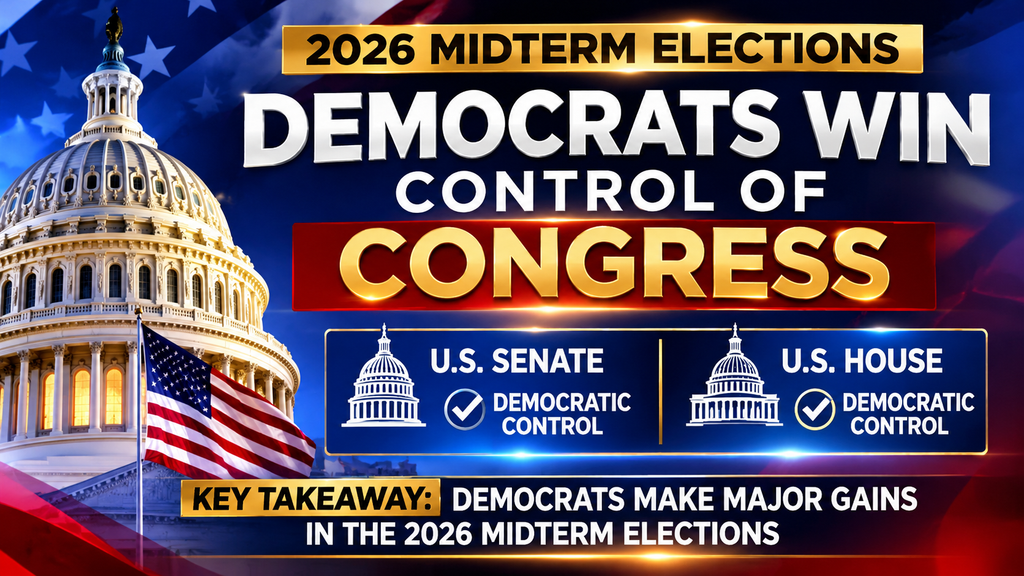
Democrats are celebrating a major political victory following the 2026 midterm elections, securing control of both the U.S. Senate and House of Representatives in a sweeping election-night performance that reshaped the balance of power in Washington.
The November 3 election delivered significant gains for Democrats, who flipped several traditionally Republican-held seats and made advances in states that have long been considered conservative strongholds. The results represent a major setback for President Donald Trump and congressional Republicans as the administration enters the second half of its term.
In the Senate, Democrats secured control of the chamber after gaining at least seven seats. As of November 7, Democrats were positioned to enter the next Congress with at least 54 seats, compared with 44 Republicans. Two races, in Alaska and Mississippi, remained uncalled as election officials continued counting outstanding ballots.
Among the notable Democratic victories were James Talarico in Texas, Sherrod Brown in Ohio, Adam Hamilton in Kansas, Josh Turek in Iowa and Annie Andrews in South Carolina. The victories were particularly significant in states where Republicans have maintained strong electoral support for decades.
Democrats also reclaimed the House of Representatives, picking up dozens of seats and ending Republican control of the chamber. While several races remained unresolved, the party’s gains marked one of the most consequential midterm shifts in recent decades.
The election results extended beyond Capitol Hill. Democrats also made gains in gubernatorial and statewide contests, including victories in Georgia, Iowa, Ohio and Texas, where control of governor’s offices changed parties.
In Georgia, Keisha Lance Bottoms made history by winning the governor’s race, becoming the first Black woman elected governor in the United States. Her victory was among several high-profile outcomes that reflected the broader political shifts taking place across the country.
Economic concerns, particularly the cost of living and inflation, were among the major issues influencing voters. Concerns about the direction of the country, the administration’s policies and government accountability also shaped the election environment.
With control of both chambers of Congress, Democrats will have greater influence over the legislative agenda, congressional investigations and oversight of the Trump administration. The shift is expected to create a more challenging political environment for the president as lawmakers prepare for the next legislative session.
Although some races remain outstanding, the overall outcome is clear: the 2026 midterm elections have significantly changed the political landscape, giving Democrats control of Congress and setting the stage for a new chapter in Washington.
About the Author